

I just saw the movie The Aviator (1985) last night with Christopher Reeve and Rosanna Arquette. It’s actually not a movie about flying as much as it is a movie about wilderness survival. If you’ve been on the fence about watching it, I can say that I enjoyed it.
There’s some childish cliches about it, like a whole subplot involving scary wolves. But the shot-on-location scenery is spectacular, as are the costumes. I caught myself wondering what I’d do throughout most of the movie, and that’s probably the best part about movies like this - it gives your imagination a chance to play through certain scenarios.
One example: Arquette is injured and Reeve needs to be able to transport her, but he doesn’t have the energy to carry her. So he builds an Indian “travois” from a few trees (those platform-like things that could be pulled behind horses or behind a man pulling it).
Anyway, I’m watching Reeve pull her on this thing and I’m thinking, that’s way too short. If he made those poles much longer in length and put her down at the tail end of it back behind him, it would require about half the energy to pull her around like that…
But I really enjoyed the film. It’s one you can watch around your kids no problem. I recommend it, it was fun. It’s currently available on Prime, but will be gone by the end of the week.


Braving the Ol’ Shawnee Appalachy - Pt 1: The Easy Part
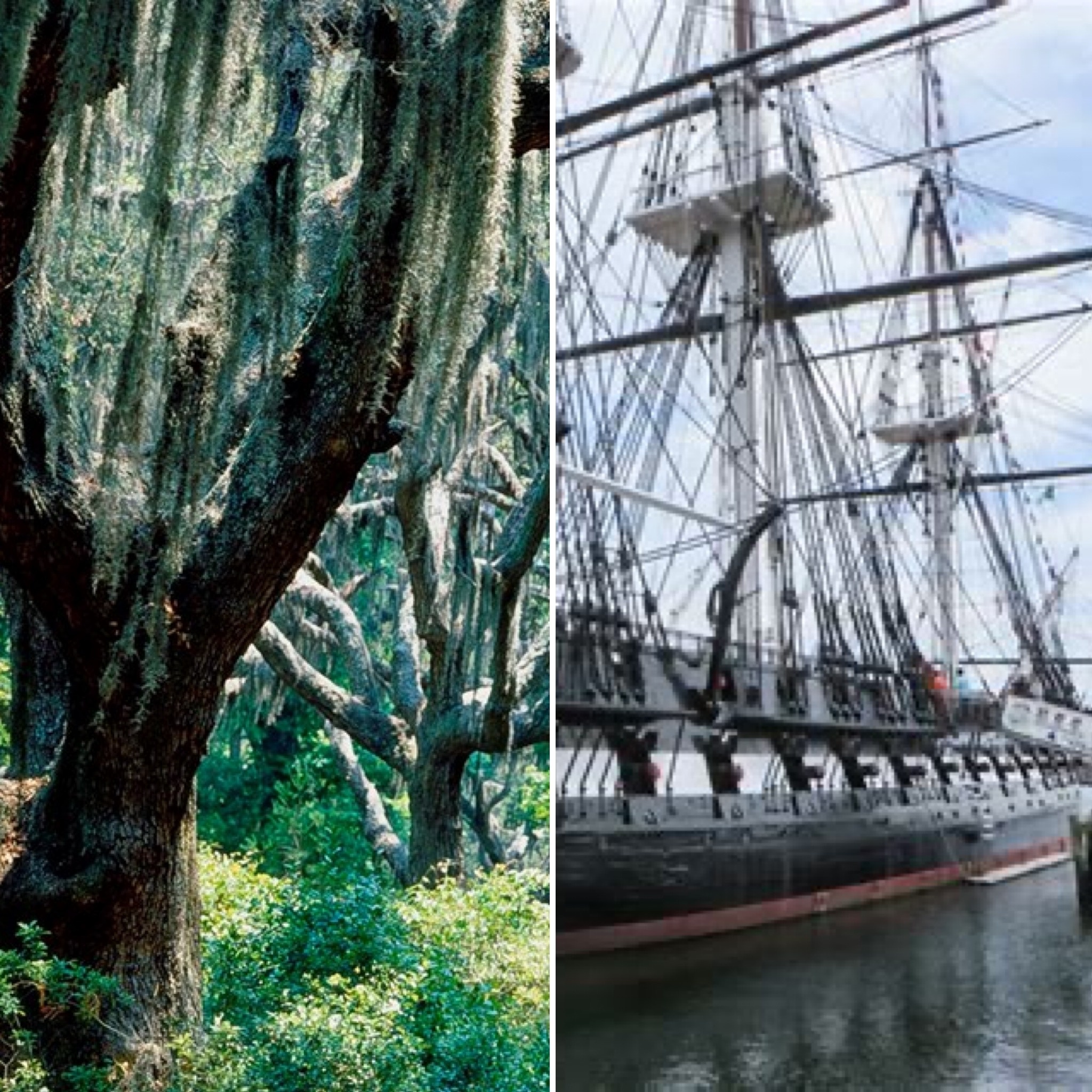
"Her sides are made of iron!" a sailor shouted as British cannonballs bounced off the USS Constitution in 1812. They weren't. They were made of Georgia live oak, and getting that wood nearly killed the men who cut it.
When Congress ordered six new frigates built in 1794, designer Joshua Humphreys wanted them bigger and tougher than any frigate in the world. That meant one tree: the southern live oak.
Live oak is a strange tree. It doesn't grow tall and straight. It grows low and wide, with massive limbs that twist out sideways. That's exactly what shipbuilders wanted. A warship's skeleton is full of curves, the ribs and the braces that hold the decks to the hull. Cut those curves from straight lumber and you slice across the grain and weaken the wood. With live oak, you could find a limb that had already grown into the shape you needed, grain and all. It's also one of the densest, hardest, most rot-resistant woods in North America.
The best stands were on the Georgia coast. So starting in 1794, ...